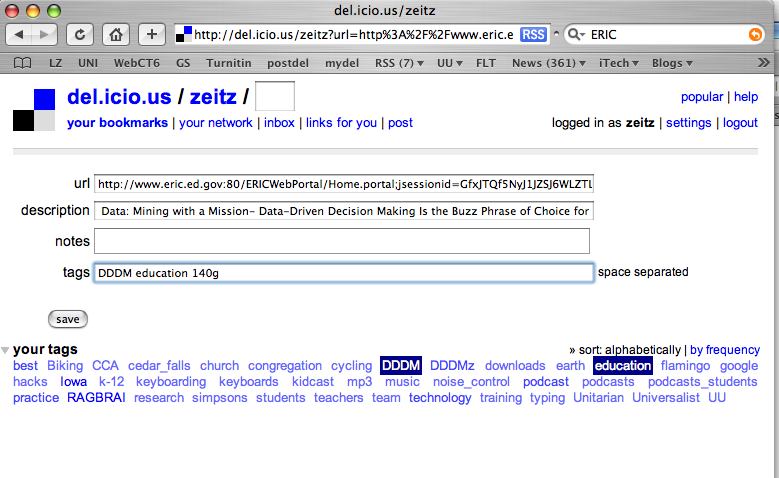
This assignment involves finding, reviewing, analyzing and discussing articles that deal with Data-Driven Decision Making. There are many issues that arise when an educator is attempting to improve an educational environment based upon the information from and about the environment. This is a multi-phase assignment. Phase 1: (Create a del.icio.us account) It's Del.icio.us!! We will need to have some way to organize the resources that students find so we will use the website entitled, del.icio.us. This is HUGE database designed to allow you to "Share your favorites" with your friends and colleagues. If you don't already have a del.icio.us account, you will need to create a del.icio.us account. This involves entering a username and password. Then you install Del.icio.us buttons onto the window of your favorite browser. These buttons will make it easy to add websites that you find to your del.icio.us account. You can create your these buttons by going to the del.icio.us buttons page. There you will find directions for dragging specific links to the "bookmarks bar" of your browser. Phase 2: Find Resources Now that you have a del.icio.us account and you have a couple of buttons on the navigation bar in your browser, you are set to search for resources about Data-Driven Decision Making in Education. You can use the usual assortment of web search engines: Google, Yahoo, Dogpile, MSN, Ask or whatever. If you want to be a little more scholarly in your searching, you might want to use Google Scholar or ERIC. --Search for a resource using one of these search engines. Continue this until you have found and tagged at least 10 resources. Read all of these articles and make a list of catagories that you would use to describe each article. What are the key words that you bring away from reading this article? Phase 3: Class Chat In class, we will discuss the articles that were discovered. Here we will discuss the list of categories that we created and identify the ones that we will be using. You will select a category that you want to research. We will work together to assign the categories. Return to your del.icio.us account and tag your resources accordingly. Tagging your resources will make them more available for your classmates. This means that you will need to tag your articles promptly so that everyone else will be able to access your articles appropriately. Phase 4: Prepare the Article Discussion Using del.icio.us, identify an article within your category that you want to discuss with the class (discussion process listed below). This article must be a substantial enough resource to provide background for the discussion. You must also find a case study to use as an example of the concept identified in this article. Task: Read and synthesize the selected article. After reading it, you are to begin a discussion on the appointed discussion board during the appropriate week. This means that you begin with brief paragraph about the article and then ask a question that will require your colleagues to do some serious thinking before answering. It can be tricky to ask the correct question. The RIGHT Question: You don’t want to use just a recall question that asks something like, “How many school districts were mentioned in the article?” You want to ask something that involves analysis of the information covered. You might ask, “What were the probable positive outcomes from collecting all of the necessary data?” or “How would you have implemented this differently if you were creating this system?” After posting this question, you will need to monitor the discussion. Respond to the students’ ideas. Make connections between the students’ responses. Don’t tell them if they are right or wrong. Extend their thinking with another question or comment. Student On-line Participation: Each student is expected to post at least one response to the leader’s question. Each student is also expected to respond to at least 2 other students’ postings. While there are no points appointed for this assignment, it will affect your participation grade. In Class: Lead a discussion about the article during classtime. Begin with a brief review of the article. List some of the important points. Pose at least two questions for the discussion that weren't used in the on-line discussion. Lead the discussion eliciting ideas and conversation between the class members.
Last updated 8/31/06 by Leigh Zeitz |